Prime Minister Kurti Participates in the Commemoration of International Romani Language Day
Prishtina, 5 November 2026 / Prizren, 4 November 2026
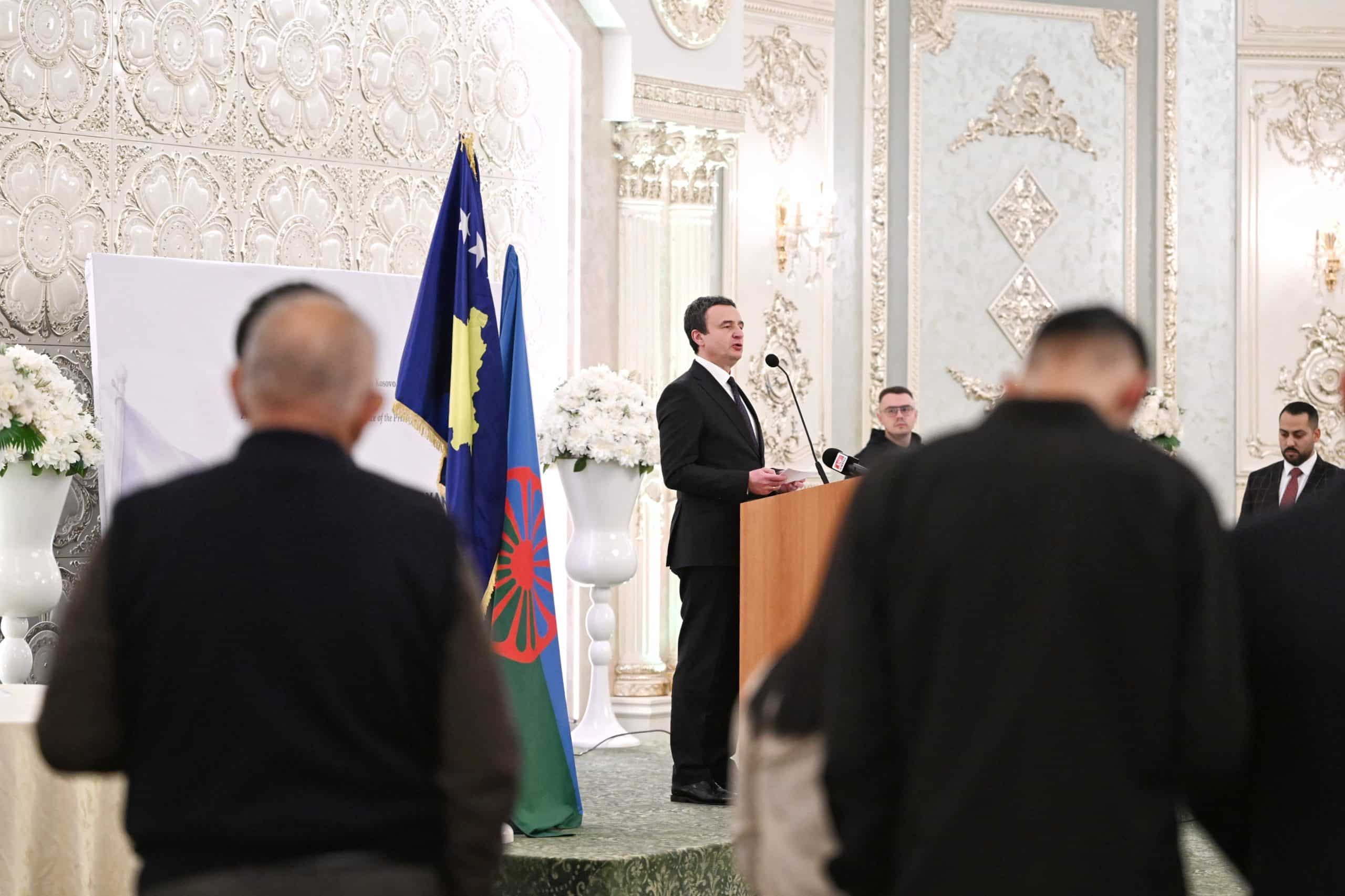
On the eve of 5 November, the Prime Minister of the Republic of Kosovo, Albin Kurti, yesterday evening participated in the commemoration of International Romani Language Day in Prizren, together with institutional representatives and members of the Roma community.
In his opening remarks, Prime Minister Kurti said that the Romani language is not merely a matter of legal norms and rights, but a cause, an act of resistance, and an ongoing act of existence.
“Through its cultural diversity, Kosovo has both the potential and the responsibility to demonstrate that coexistence is not merely the presence of different communities in the same space, but also the mutual recognition, respect, and promotion of their heritage. In the face of intergenerational assimilation pressures, the Roma community in Prizren has established important cultural centres, built around a clear cause: preserving the Romani language, culture, and identity,” he said.
Prime Minister Kurti spoke about the range of measures and supportive policies for the Roma community, including scholarships for students as an opportunity for academic empowerment.
“The Ministry of Education and Science is working intensively to include the history, culture, and traditions of the Roma community in pre-university education textbooks, as well as to revise the curriculum for elective Romani language classes and publish new school textbooks in this language,” the Prime Minister emphasised.
Full speech of Prime Minister Kurti:
Honourable Chair of the United Roma Party of Kosovo and Member of the Assembly of the Republic, Mr Albert Kinolli,
Honourable Deputy Speaker of the Assembly of the Republic, Ms Emilija Rexhepi,
I Honourable Sejnur Veshall, Deputy Minister of Sport and Youth,
Honourable Members of the Assembly of the Republic, Fridon Lala, Artan Asllani, Bahrim Shabani, and Fatma Thaçi,
Distinguished guests,
Ladies and gentlemen,
Sisters and brothers,
At the heart of every democracy lies a moral principle: individuals and communities cannot be reduced to numbers. Rights are not privileges or favours that we must ask for; they are rights that belong to us and to which we are entitled. This idea is not new, nor am I the one saying it, but it dates back to the IV century before our era. Phaleas of Chalcedon dealt with issues of inequality and social justice. This proves that equality and social justice have been among the fundamental issues of political thought since antiquity.
Language is one of the foundations of this equality.
The Romani language is not merely a matter of legal norms and rights guaranteed on paper. It is a cause, an act of resistance, and an ongoing act of existence. For every language that struggles to survive in the face of oblivion, marginalisation, and silence becomes a form of collective resistance. The protection of the Romani language is certainly a demand for institutional recognition, but it is also a demand for dignity, identity and the right to be part of history without giving up who you are.
Kosovo has both the potential and the responsibility to demonstrate, through its cultural diversity, that coexistence is not merely the presence of different communities in the same space, but also the mutual recognition, respect, and promotion of their heritage. In the face of intergenerational assimilation pressures, the Roma community in Prizren has established important cultural centres, built around a clear cause: preserving the Romani language, culture, and identity.
These efforts are not merely cultural activities. They are expressions of awareness and historical continuity. Cultural movements also have a political dimension when they defend an identity, articulate a cause, and build an enduring connection between love for one’s heritage and the determination to protect it.
It is this same love and perseverance that have enabled traditional Romani songs to survive across generations. Even during periods when access to education and opportunities to read and write were limited, these songs were passed down orally from one generation to the next. Through this oral heritage, the Roma community has preserved not only melodies and words, but also its memory, experiences, and worldview.
In this context, the work of British anthropologist Amelia Abercrombie reminds us of the cultural richness that our country, Kosovo, holds.
Think for a moment. A British anthropologist comes to Prizren, stays here to study the Roma community, learns the Romani language and researches the connections between language, identity, history and social relations. Afterwards, she turns this experience into an academic work that takes the experience of Kosovo’s Roma community into the international sphere of knowledge.
During her stay in Prizren, from September 2013 to March 2015, Abercrombie conducted ethnographic research on the Roma community in Terzimahallë and the activities of the non-governmental organisation Durmish Aslano. Her research culminated in the book Mixing and Unmixing Languages. Romani Multilingualism in Kosovo, published by Routledge in 2021. This is a significant example of the value Kosovo holds as a space of study, memory and cultural heritage. Prizren is not merely the place where this story has lived, but also the place from which it can be understood and shared with the whole world.
We see Roma as an integral part of our shared identity and as living evidence of the deep multiculturalism that has shaped our society over the centuries. The Romani language and Roma identity are preserved because the memory, traditions, way of thinking and spiritual heritage of a people are preserved.
Honourable attendees,
In this speech, I wish to emphasise that the preservation of the Romani language cannot remain merely a declarative commitment; it requires concrete actions, institutional responsibility and continuous cooperation.
In this regard, I wish to share with you five concrete commitments:
• At the Ministry of Education and Science, intensive work is under way to include the history, culture and traditions of the Roma community in pre-university education textbooks, as well as in
• The revision of the curriculum for optional Romani language instruction and the publication of new textbooks in this language.
• At the Ministry of Culture and Tourism, the documentation for the inclusion of traditional Roma songs and dances within the framework of the protection of intangible cultural heritage is being addressed, at the request of the NGO “Durmish Aslano”. This will be an important step towards the institutional recognition and protection of a heritage that has survived over the centuries.
• Within the Office of the Prime Minister, we aim to consolidate support for activities that contribute to the protection and development of the Romani language. In this context, Roma media must have the necessary institutional support, because they are not merely means of information, but also key spaces for the preservation and development of the language.
• In terms of educational support, the awarding of scholarships to students from the Roma, Ashkali and Egyptian communities is continuing, as an opportunity for their academic and professional empowerment.
In the international dimension, for the first time within the framework of this Government, a special commitment has been requested from Deputy Minister Sejnur Veshall to develop dialogue, cooperation and build Roma diplomacy with Roma organisations and representatives in Europe. The visit to Berlin and the confirmation of cooperation with ERIAC (European Roma Institute for Arts and Culture) constitute a concrete step in this direction.
Dear friends,
In the end, I would like to share with you a few verses from the poem “The Bridge”, which, in a way, also summarise what I wished to convey through this speech, because, just like a bridge, which does not serve only to connect two banks of a river, but also to offer entire worlds, to carry memory and to overcome distances. And you know that our government, your government, is a government of bridges. Yes. Those that we have built in Mitrovica and elsewhere, but also of spiritual, cultural, educational, economic, trade bridges, and so on. And I will read only two lines of this poem, which perhaps speak even more than my speech.
“You are my bridge,
From the balcony of the moon to the windows of the sun”.
Sejnur Veshall.
Bahtalo Romalen! Congratulations!